
CFD trading is one of the most common entry points into global financial markets — and also one of the most misunderstood. Contracts for Difference allow traders to speculate on price movements across forex, indices, and commodities without owning the underlying asset. This guide walks through the essentials step by step, with a consistent focus on the risk awareness that separates informed traders from those who learn hard lessons expensively.
The Basics
What Is CFD Trading and How Does It Work?
A Contract for Difference is a derivative instrument: rather than purchasing an asset outright, you agree to exchange the difference in the asset's price between when you open and when you close a position. If the price moves in your favour, you profit; if it moves against you, you incur a loss — all without ever owning the underlying stock, commodity, or currency pair.
This structure gives CFDs three defining characteristics that make them both attractive and demanding for new traders.

Go Long or Short
-
Buy (go long) if you expect the price to rise
-
Sell (go short) if you expect the price to fall
-
Profit in both rising and falling markets
Multi-Asset Access
-
Forex pairs — EUR/USD, GBP/JPY, and more
-
Global indices — S&P 500, FTSE 100, DAX
-
Commodities — gold, oil, silver
Accessibility
Why Beginners Choose CFD Trading
CFDs attract beginners primarily because of their flexibility and low barrier to entry. With platforms like FISG and InterStellar Group, traders can access professional-grade tools and a wide range of instruments starting with relatively modest capital — without needing separate accounts for each asset class.
That said, accessibility is not the same as simplicity . The features that make CFDs appealing — leverage in particular — are also what make education non-negotiable before placing real money at risk.

The easiest part of CFD trading is opening an account. The hard part — and the rewarding part — is building the knowledge and discipline to use it well.
Step-by-Step
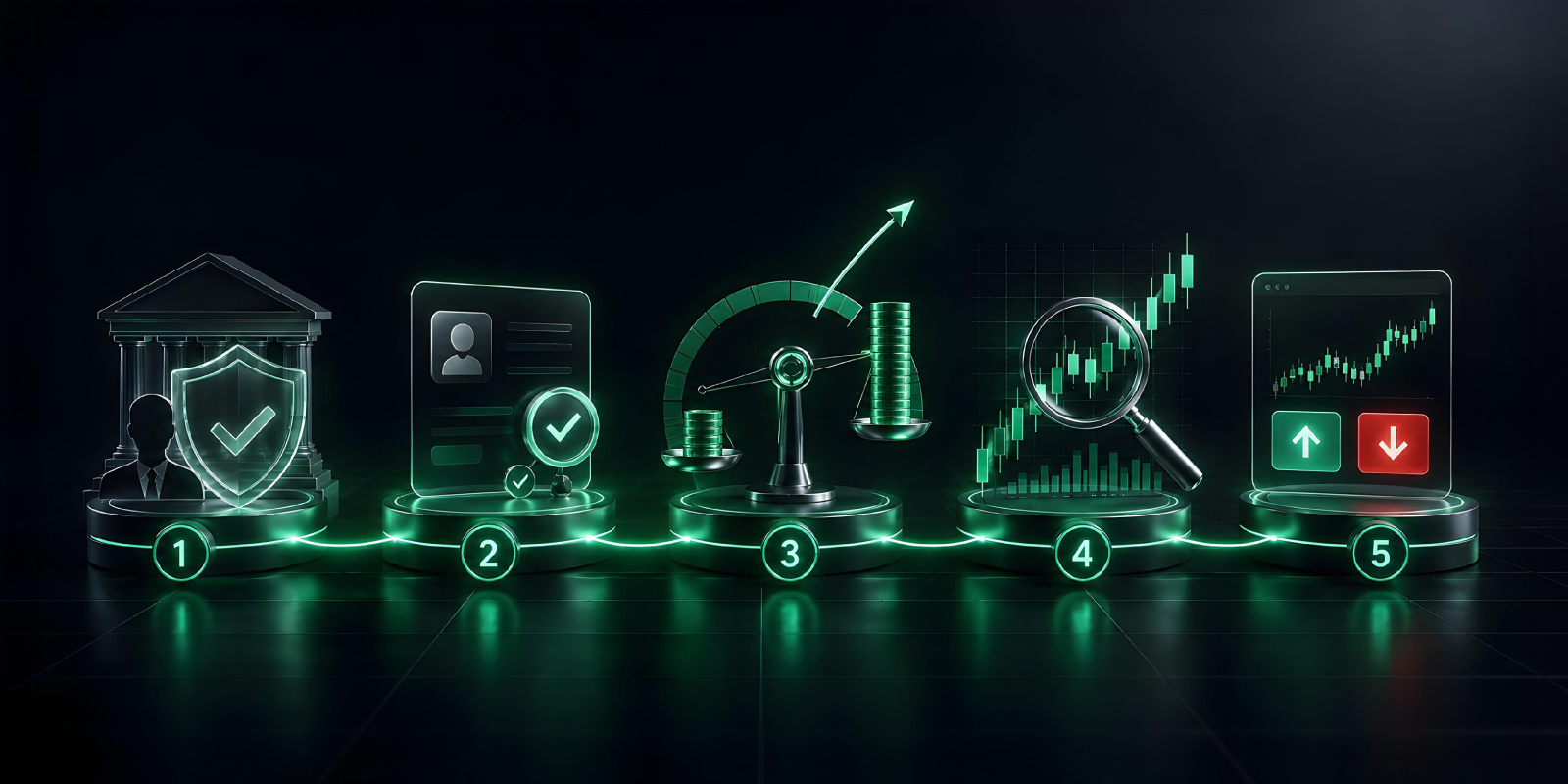
How to Trade CFDs: A Practical 5-Step Process
Getting started with CFD trading is a structured process. Each step builds on the previous one — skipping ahead without the foundation in place is one of the most common reasons beginners run into avoidable difficulties early on.
-
01
Select a Reliable, Regulated Broker
Your broker is the foundation of everything that follows. When evaluating platforms such as FISG, prioritise:
- Active regulatory licence (FCA, ASIC, CySEC)
- Transparent trading conditions and fee disclosures
- Platform stability across desktop and mobile
- Quality of educational resources and customer support
-
02
Open and Verify Your Account
Account setup involves registration with personal details, KYC identity verification, and selection of account type. Regulated brokers implement these steps to align with compliance standards and protect account security — the process is straightforward and takes minutes.
-
03
Understand Leverage Before You Use It
Leverage is the most powerful — and most misunderstood — feature of CFD trading. It allows you to control a position much larger than your deposit, amplifying both gains and losses equally. Study the leverage example below before progressing.
-
04
Learn Basic Market Analysis
Even a foundational understanding of how to read price action and interpret economic data gives you a meaningful edge over purely reactive trading. Focus on one method first — master it before adding more.
-
05
Execute Your First Trade with Risk Controls in Place
Select an asset, decide direction, set your position size — and always define your stop-loss before entry. A trade without a stop-loss is not a trade with a strategy; it is a bet with no defined exit.
Step 3 in Detail · Leverage Example · 1:20
Your Deposit $200 Initial margin
Leverage Applied 1:20 Multiplier
Market Exposure $4,000 Total position size
Market Analysis
Technical and Fundamental Analysis for Beginners
Successful trading requires at least a working understanding of why prices move. Most beginners start with one of two approaches — or a combination of both. Neither is universally superior; the best fit depends on your trading style and the instruments you focus on.
Technical Analysis
-
Price charts and candlestick patterns
-
Trend lines and support/resistance levels
-
Moving averages (SMA, EMA)
-
RSI, MACD, and other momentum indicators
-
Volume and price action signals
Fundamental Analysis
-
Central bank interest rate decisions
-
Inflation data (CPI, PPI)
-
Employment reports and GDP releases
-
Geopolitical events and risk sentiment
-
Earnings and sector-specific news
Costs & Risk
Trading Costs, Risk Management, and Common Mistakes
Understanding what you pay to trade — and how to protect yourself when trades go wrong — is as important as any entry strategy. Beginners who focus only on potential gains while ignoring costs and risk controls consistently underperform those who treat these as foundational.

| Cost Type | What It Means |
|---|---|
| Spread | The difference between the buy and sell price. This is the primary cost on most CFD trades and varies by instrument and market conditions. |
| Commission | A per-trade fee charged on some account types, typically in addition to a tighter spread. Common on ECN/raw spread accounts. |
| Overnight Financing | A daily charge applied to positions held open past market close, based on the notional value of your position and prevailing interest rates. Relevant for swing traders. |
Core Risk Management Rules for Beginners
-
Always set a stop-loss before entering a trade — Define your maximum acceptable loss at the point of entry, not after the market moves against you.
-
Risk no more than 1–2% of capital per trade — A single loss should never be large enough to impair your ability to continue trading with a clear head.
-
Avoid excessive leverage as a beginner — Start at the lower end of available leverage (1:5 to 1:10) until your strategy is consistently tested and understood.
-
Do not trade multiple unfamiliar instruments simultaneously — Learn one or two instruments well before diversifying. Breadth without depth is a recipe for distraction.
-
Use a demo account before trading live capital — Practice your strategy in a risk-free environment until you are consistently applying your rules, not just occasionally.
Common Beginner Mistakes
-
Trading Without a Strategy — Entering trades based on impulse or market noise rather than a defined, testable plan leads to inconsistent results that are impossible to learn from.
-
Misunderstanding Leverage — Treating leverage as a multiplier of gains without recognising it equally multiplies losses is the single most common cause of account wipeout among new traders.
-
Overtrading — Placing too many trades — often driven by boredom or the urge to recover losses quickly — increases exposure, costs, and emotional decision-making simultaneously.
-
Focusing Only on Potential Returns — New traders who evaluate trades primarily on how much they could win, rather than the probability-weighted expected value and downside, systematically take on more risk than they realise.
Self-Assessment
Is CFD Trading Suitable for You as a Beginner?
CFD trading can be a genuinely effective way to access global markets — but it is not suitable for everyone, and recognising that is itself a form of financial intelligence. Before committing real capital, take an honest look at three personal factors.
Before You Start — Consider Honestly
-
Your financial situation — Only trade with capital you can genuinely afford to lose entirely. CFD trading should never involve funds earmarked for living expenses, savings goals, or emergency reserves.
-
Your risk tolerance — If a 20% drawdown on your trading account would cause genuine distress, either reduce your position sizes or reconsider the instrument. Emotional trading is expensive trading.
-
Your level of market knowledge — There is no shortcut here. A demo account is the right starting point for every beginner, regardless of background. Use it until your rules — not your instincts — are consistently driving your decisions.

Final Thoughts
Building a Foundation, Not Just a Position
Learning how to trade CFDs for beginners is not a single event — it is an ongoing process of building knowledge, testing strategies, and developing the discipline to follow your rules even when it is difficult. Platforms like FISG provide the tools and environment to get started, but the quality of your learning and the consistency of your risk management are what will determine whether trading becomes a sustainable part of your financial life.
Start with a demo account. Study one instrument. Build one strategy. Apply it consistently — and review the results honestly . That process, repeated with patience, is how traders develop lasting competence in the markets.
Risk Disclaimer: CFD trading involves significant risk and may not be suitable for everyone. Losses can exceed your initial deposit. It is important to fully understand how CFDs work and whether you can afford to take the high risk of losing your money before trading. This guide is educational in nature and does not constitute financial advice. Always trade responsibly and seek independent advice if necessary.
Found this article helpful?
Share it with your trading community
Related Articles
-
go to article
 CFD Trading with High Leverage: Opportunities, Risks, and Best Practices
 -
go to article
 Top MT4 Broker: How to Choose the Right Platform
 -
go to article
 How to Open FISG Trading Account: Step-by-Step Guide for Beginners